
blog/use-cases·Sep 9, 2026·6 min·by the eroq team
AI video for fitness coaches — program promos and social hooks
Program promos and social hooks on eroq without faking the coach — generated people are fictional, so your own footage stays the face of the brand.
Coaching sells on trust, and trust is a face. That single fact decides everything about how generated video fits into a fitness business — which is to say it fits around the edges, doing the work you currently do badly or not at all, and it stays well away from the work you already do better than anyone. Here is the split, a launch costed to the credit, and a prompt you can paste.
The limit that shapes everything
eroq generates original fictional characters. Not you. There is no face swap, no lip-sync, no talking avatar and no training a model on your own footage, and real identifiable people without consent are banned by policy. A generated athlete in your promo is a stranger, and a stranger demonstrating a rep is a stranger whose form nobody has checked.
So the rule is short: your own footage is the face of the brand. The set, the coaching cue, the client testimonial, the rep with your voice over it — that is you, filmed. Everything a coach films badly or never films at all is where generated video earns its keep.
It also cuts the other way, usefully. Plenty of coaches do not want to be on camera for every post, and the honest alternative to a talking head is not a fake talking head — it is atmosphere, text, abstraction and a voice. Those are cheap to generate and they sustain a posting cadence between the days you actually record.
The division of labor
Film yourself: demonstrations, form corrections, the piece to camera, before-and-afters, anything a client would be upset to learn was fabricated.
Generate: the opener that runs before every post, the empty-gym establishing shot at 5am, the hook clip behind a bold line of text, the abstract loop under a quote, the stills for the program sales page, the narration when you are not speaking.
The second list is six or eight assets a week. It is exactly the list that stops getting made in week three of a busy block.
Six hooks from one look
Social hooks are a format, not an idea: a short clip, a hard line of text over it, a cut to you. The clip does not need to depict the exercise. It needs to stop a thumb and hand over to your face two seconds later.
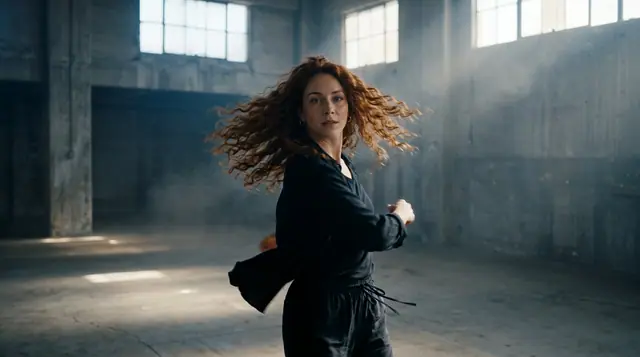
Set a house look once: Palette "Bleach bypass" and Lighting "Contre-jour" in the Settings panel, and "35mm film", an anamorphic lens, f/1.4, a commercial look and a dynamic tempo written into the prompt (the first three sit in the Syntax menu). Then change only the subject line across six renders. Empty squat rack under skylights. Chalk dust in a shaft of light. Rain on a track at dawn. A rope hitting the floor. Steam off a shoulder in cold air. A gym door opening onto sunrise.
Six clips, one identity, and none of them pretend to be a person.
The video studio also knows 24 camera moves: type "whip pan" or "crane up" in the prompt and the composer highlights it, or drop one in from the Syntax menu. Whip pan between two hooks is the cheapest energy in the format.
The hook prompt
One flowing paragraph, subject then motion then camera then light then mood:
An empty squat rack in a concrete gym before opening, slow crane up through hard morning sun falling in bars across the floor as chalk dust hangs in the light, loaded barbell resting on the pins, anamorphic lens at f/1.4, bleach bypass palette, contre-jour with deep shadows, dynamic tempo, commercial look on 35mm film, wide shot.
Shoot it in 9:16 if it is going to Reels or TikTok, 1:1 for feed, 16:9 for the sales page. Render in the shape you publish — a crop throws away the headroom you framed for, and picking the ratio is free at render time. The wider cadence for vertical content is on the social shorts use case.
If you want a recurring fictional figure — a mascot, a silhouette, an archetype for the program rather than a person — Characters is the right tool: a persistent cast entry with a name, a persona, reference photos that hold the same appearance across images and clips, and a voice, @mentionable in any prompt. Keep it visibly fictional and never imply it is a client or a coach on your team. Set one up in the characters studio.
A program launch, costed
One launch week: six hooks, two hero clips at 1080p, one spot with its own sound, eight stills for the sales page and emails, and a 1,500-character voice-over.
- Hooks — 6 × 195 on Seedance 2.0 Fast = 1,170
- Hero clips — 2 × 270 on Kling 3.0 = 540
- Spot with sound — 1 × 344 on Veo 3.1 Fast = 344
- Stills — 8 × 10 on Krea2 = 80
- Voice-over — 1,500 ÷ 100 × 3 on Voice One = 45
Total 2,179 credits, about $21.79 at the entry pack rate of $10 for 1,000 credits. Kling and Veo both open from Hobby, so Hobby at $15 for 1,800 credits carries one launch with -379 to spare, and Creator at $49 for 6,000 runs 6,000 ÷ 2,179 = 2 of them before topping up.
On Hobby at $15 for 1,800, drop the Veo spot and swap the heroes to Motion One at 145 credits for 5 seconds: 1,170 + 290 + 80 + 30 (the same script on Voice Turbo at 2 credits per 100) = 1,570 credits, so Hobby carries two launches a month with change. Credits roll over forever and failed renders refund themselves automatically.
Sound, and the thing eroq does not do
Veo 3.1 Fast renders a soundtrack with the picture: ambience, effects and dialogue in an 8-second clip for 344 credits. For a launch spot that means the rack clanking and the room tone arrive with the picture instead of being sourced separately.
It is not a music generator. eroq does not generate music at all, so your track still comes from wherever you license music today. The cut is a separate step: the hooks, your phone footage and the track meet on the timeline of the Editor (or your own editor, if you already have one), with trims, titles, cuts on the beat and an MP4 export in 9:16, 1:1 or 16:9. Plan for that step; it is where the launch actually gets assembled.
FAQ
Can I generate a video of myself coaching?
No. eroq renders original fictional people, and there is no lip-sync, no face swap and no way to train a model on your footage. Film the coaching, generate the atmosphere around it.
Should generated clips show exercises?
Be careful. A generated rep is a fictional body with form nobody verified, and form is the one thing your audience judges you on. Keep demonstrations to your own footage and let generated clips carry mood, space and text.
What does a week of content cost?
Six hook clips on Seedance 2.0 Fast is 1,170 credits, about $11.70 at the entry pack rate. Add a couple of stills and a 300-character voice-over on Voice One and a normal week is about 1,199 credits, 4,796 a month: Creator covers that, Hobby does not. Shoot the hooks on Motion One (145 credits each) and the week drops to 899, 3,596 a month, inside Hobby's 1,800.
Launching a block this month? Open the video studio, render six hooks in one sitting, and film the reps yourself.
 Video
Make it in eroq
Shoot it in Video
Everything above happens in the studio: same engines, same settings, rendered on your click.
Prompts from this article
40 free credits · no card · private mode on every account